April 20, 2026
Forum promotes using ‘social IP’ to help solve social challenges




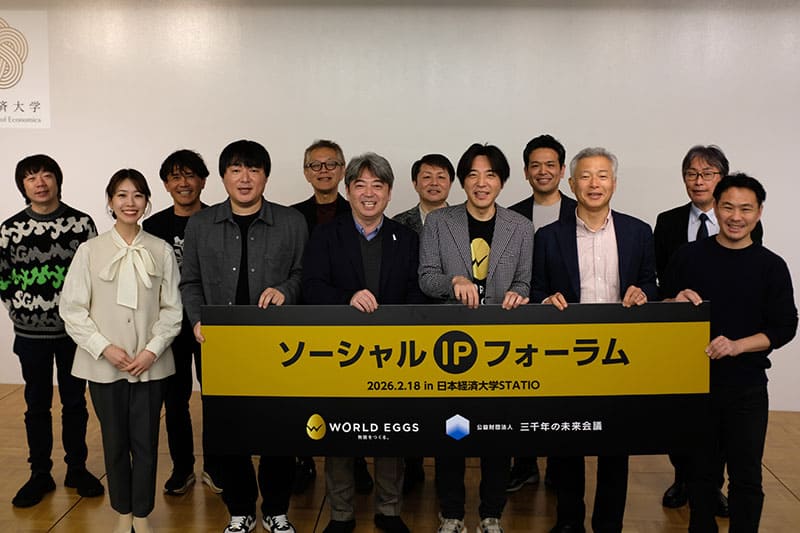
A forum exploring the potential to transform social challenges into opportunities for creating new value was held in Tokyo’s Shibuya Ward on Feb. 18. The event was co-organized by World Eggs, a consulting firm specializing in planning and managing projects that address social issues, and the Millennium Sustainability Foundation, a public-interest incorporated foundation dedicated to the revitalization of Japanese culture and local communities.
Over 140 participants from many companies and organizations gathered to discuss how they can initiate or participate in such projects through a deeper understanding of “social IP,” a new concept introduced by World Eggs to redefine solutions for social issues as “intellectual public properties.”
World Eggs CEO Katsunori Namifusa noted in his opening remarks that projects and activities intended to address social issues often suffer by lacking an effective presentation of clear purpose and thorough discussion to define a strategy for long-term viability. “We need to turn social activities and public projects into intellectual public properties that people want to participate in, talk about and support,” he stated. He added that to achieve this, it is essential to articulate the purpose of these projects in concise terms, create experiences that foster public engagement and ensure that they make business sense so they remain both scalable and sustainable.
He cited the Olympic Games and the Shikoku pilgrimage — known as the henro, which consists of long-distance treks visiting 88 temples — as quintessential examples of successful social IPs. “The Olympic Games not only celebrate sports and athletes but also symbolize peace, diversity and other universally important elements while offering people excitement and fascination. That is why nations and companies across the world offer it their full support,” he said. He also noted that the henro has consistently contributed to local economies along the pilgrimage route for the 1,200 years since its beginning. “These traditions would not have been sustained by righteousness alone,” he emphasized.
The first session featured a unique format in which presentation videos of four projects, either imagined or still in the conceptual stage. These were followed by commentary from three panelists. The projects were all aimed at creating new social IPs and demonstrating their successful use.
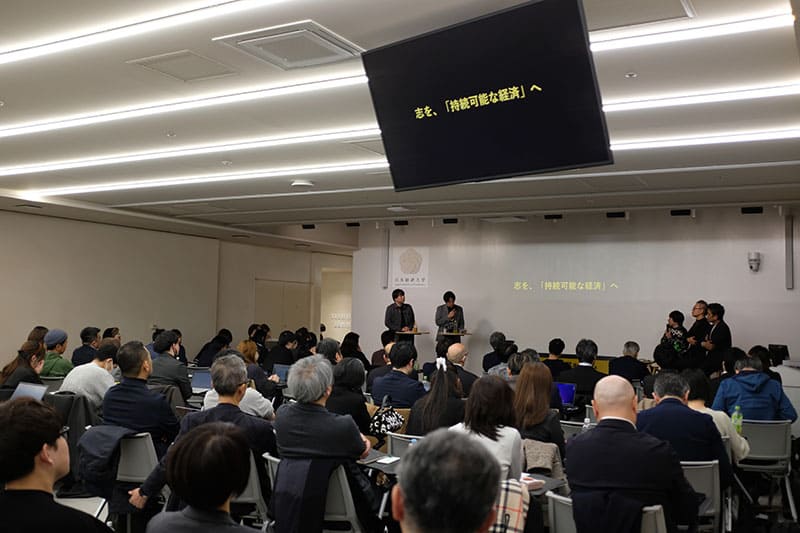
The first project focuses on utilizing lighthouses in Japan. There are approximately 3,000 lighthouses in Japan, according to the presentation, and the project aims to connect about 50 of them by sea routes, offering visitors the unique experience of standing at the edge of the land while exploring the history and stories of each location.
The second project involves animating and digitally archiving Japanese folktales. Namifusa argued that these tales embody a reverence for nature, the belief that one’s actions ultimately return to oneself and the idea that all things possess a divine spirit. He also noted that these concepts, which are considered traditional Japanese values and ancient wisdom, align with the SDGs. The panelists agreed that such an archive, if presented effectively, would be highly valued globally.
The third project is an initiative to promote Japan’s unique fish preparation and cooking methods. The fourth involves efforts to promote the understanding and preservation of watershed environments and cultures. It has introduced a new perspective of viewing rivers not as administrative boundaries but as “connecting nodes” that contribute to the sustainability of various organisms, including humans, in watershed areas.
The three panelists — Shinichi Ikenoue, a professor at Hokkai School of Commerce who specializes in urban and regional planning and management; Shunpei Shimada, representative director of Satoyume Co. Ltd., a consulting firm dedicated to regional revitalization; and Tokutaro Nakai, representative director of the Millennium Sustainability Foundation and a former environmental bureaucrat — sympathized with the ideas and shared the inspiration they received from the presentations.
In the second session, the discussion centered on how to channel funding toward activities that hold value but lack economic rationality. Three panelists — a business producer, an investor and consultant, and a fundraiser — exchanged views especially on how to increase corporate donations for socially meaningful activities. They highlighted the need to more strongly link investments in solving social issues to corporate branding, to develop methods to calculate the social impact of companies’ contributions and to create a framework for companies to support individuals engaged in social-good activities, suggesting as one possibility a system that involves giving people “social action points” that can then be purchased by companies.
In the final session, Namifusa discussed methods for transforming entertainment content into social IP, using examples from projects he is leading. The speakers, who included Tokumaru Oguri, the executive chairperson of the World Cosplay Summit, along with representatives from the gaming and radio industries, discussed how “passion,” in addition to “righteousness,” is essential to move people. They emphasized that projects must be designed so that enjoying entertainment inherently becomes a form of participation in socially meaningful action.