April 20, 2026
Originator Profile advances tech against misinformation and fraud
Event coverage




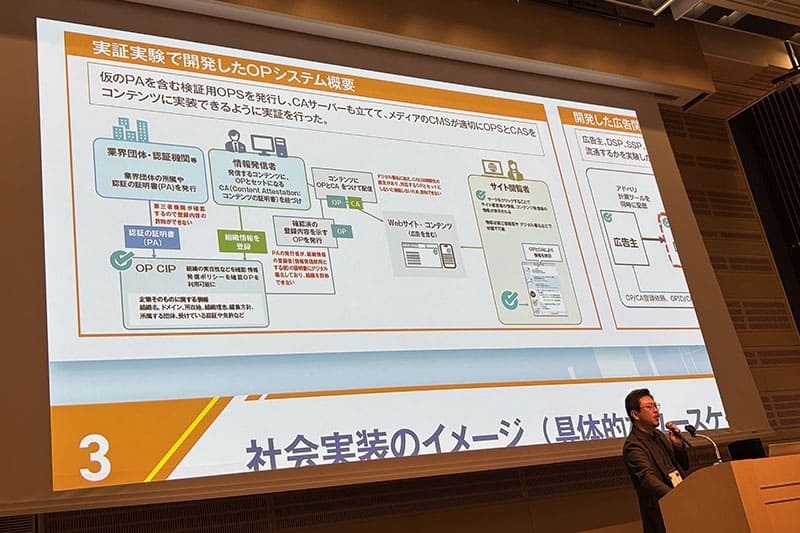
Companies and organizations involved in technologies to reduce misinformation online presented their achievements at an event organized by the Ministry of Internal Affairs and Communications at Otemachi Sankei Plaza in Tokyo’s Chiyoda Ward on March 16. As risks increase, including misinformation created using AI, the ministry has been inviting companies and organizations to participate in the Development and Demonstration Projects for Countermeasure Technologies against Dis-/Mis-information on the Internet since 2024.
This event began with a keynote speech by Kazutoshi Sasahara, a professor at the Institute of Science Tokyo, that highlighted the speed at which fake information spreads and its increasing sophistication, as well as the current state of technological advancement designed to counter it. This was followed by a series of five-minute presentations from the 14 companies and organizations selected to participate in the projects for fiscal year 2025.
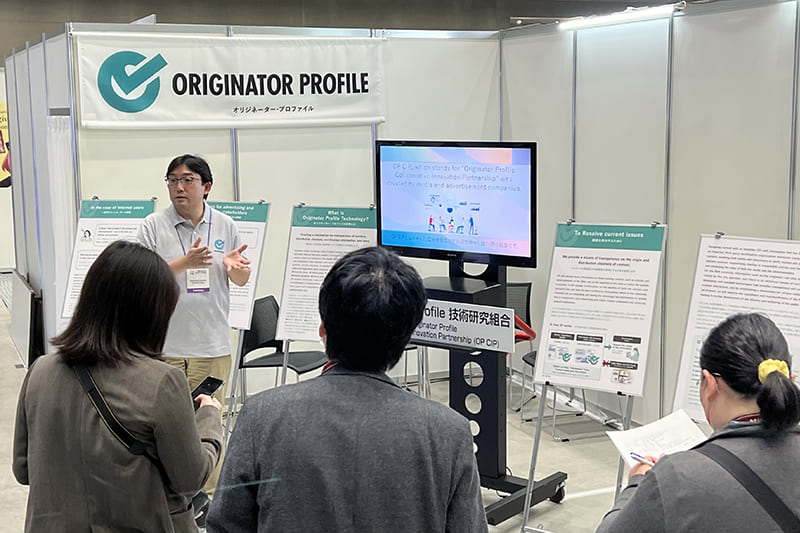
In the venue’s exhibition area, the companies and organizations had set up booths to showcase their achievements, along with two of the six research institutes selected by the ministry to participate in the projects. The area was crowded with people interested in the exhibitors’ technologies, products and services and exploring possibilities for collaboration.
One organization selected to participate in the ministry’s projects for two consecutive years is the Originator Profile Collaborative Innovation Partnership (OP-CIP), of which The Japan Times is a member.
Originator Profile is a technology that allows internet users to verify who created and published the content they are viewing and who operates the website so they can be sure the content has not been tampered with, helping them determine for themselves whether the sources are trustworthy.
In his five-minute presentation, Kazuki Kuniya, OP-CIP’s deputy secretary-general, explained that the partnership currently consists of 48 companies. “These companies, which transmit information via the internet — including media outlets and other businesses — register information such as their names, addresses, philosophies and editorial policies with OP-CIP. We verify the registered information by consulting third-party organizations such as industrial organizations that the companies belong to, to ensure that no false information is registered,” he said.
Once the registered information has been confirmed, an Originator Profile — a certificate certifying the organization’s authenticity — is issued, which can then be embedded into the content published by the organization. Kuniya also explained that a certificate called a Content Attestation (CA) is issued for each piece of content published by the organization. “Using a browser function, viewers can verify the OP and CA to ensure that the content has undoubtedly been published by an OP holder.”

During this fiscal year’s project, funded by the ministry and involving 17 companies including media firms and five advertisers, some of these companies adopted this technology for online advertising in real environments. By embedding OP in ads, users can verify the identities of advertisers, helping them identify the authenticity of ads and avoid phishing scams.
Kuniya believes the social implementation of this technology will be highly beneficial for municipalities and media outlets, where the authenticity and accuracy of information is critical, especially during disasters and other emergencies. He cited the example of the false claim of an escaped zoo lion that spread after the 2016 Kumamoto earthquake and emphasized the importance of being able to quickly determine whether information is reliable. He added that it will also benefit companies, including financial institutions, which suffer damage from fraud.
Following his presentation, Kuniya spoke with The Japan Times, saying the pilot project also revealed new challenges. “We learned that not all companies can easily integrate OP into their existing systems, partly because some have complex systems or outsource the development of their systems — this was a significant finding,” said Kuniya. As a first step toward solving this problem, OP-CIP has already begun distributing plugins for WordPress, which he described as the most versatile content management system. “We recognize the need to make OP implementation easier by developing a wider range of CMS plugins” and using software as a service, he said.
Kuniya expressed his hope that not only the current OP-CIP members but also a wider range of companies and other social stakeholders will participate in OP’s pilot program this year and beyond: “This will help us understand various circumstances unique to each industry and sector, which will define the direction of the further development of OP technology.” He also noted the importance of raising awareness among internet users, saying, “We hold events such as symposiums quite frequently. We also receive a lot of media coverage; just the other day, the OP-CIP’s secretary-general appeared on a television program sponsored by the ministry to explain the OP.”
Kuniya also said that in order to enable internet users to utilize OP automatically, OP-CIP aims to establish OP as an international standard and have it preinstalled in browsers in the future.“While this is just my personal opinion at this stage, I would like to see OP technology being used to identify the sources of videos and emails in the future,” he added.
“It is said that fake information spreads faster than anything else.” “By using OP to verify the source of information, people can avoid becoming the ones who spread misinformation.”