December 05, 2025
Poppins supports working women in every stage of life
SPONSORED CONTENT




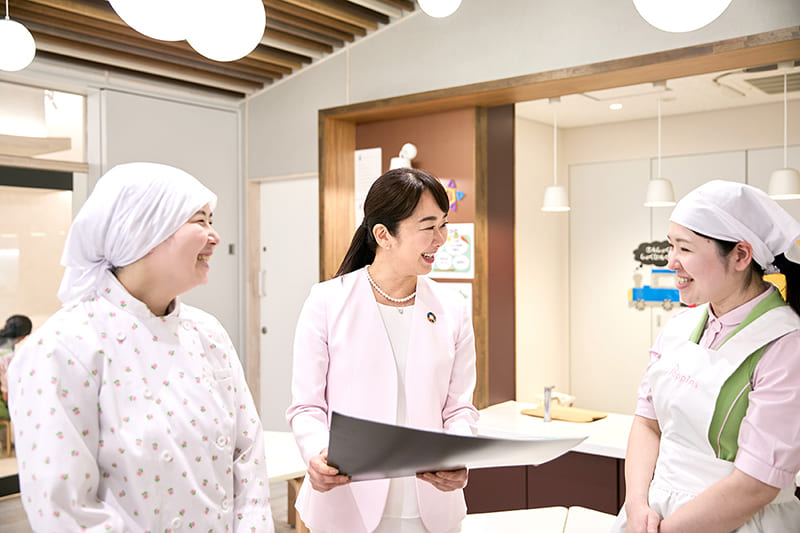
For 38 years, Poppins Corp. has provided services that support women at every stage of their lives and careers, from babysitting to elder care. In its EduCare business, which provides child care at 325 locations nationwide, Poppins pursues its own theory of child care, with a strong focus on research and training for staff. Poppins has also expanded into pet care and services for preventing infertility. A common thread running through all of these businesses is a focus on solving social issues.
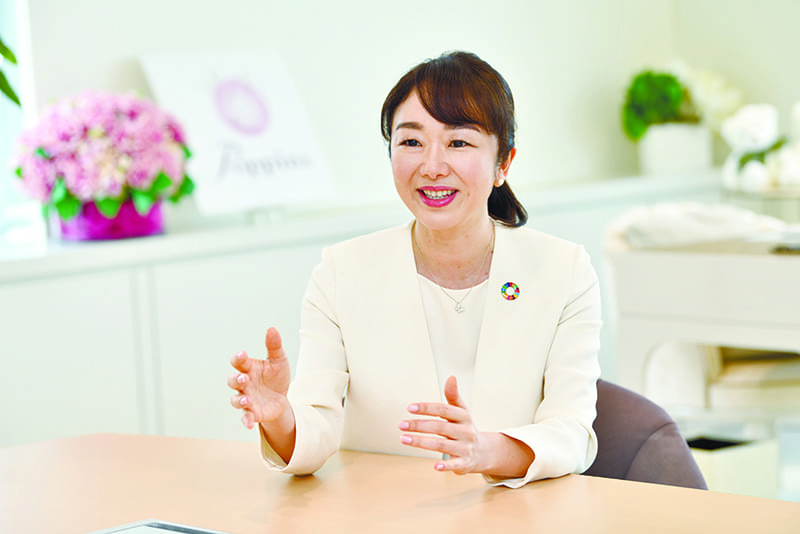
When Poppins went public in 2020, it branded its IPO as an “SDGs-IPO” with two main goals. The first was to show its shareholders and the public that solving social issues can be a driving force for business. The second was to elevate the social standing of essential workers to help them take pride in their work. “We need a social structure where sustainability generates profit,” said Maiko Todoroki, the company’s president and CEO.
Five years on, Todoroki said Poppins has been able to visualize the impact its business has had on society and establish itself in the market as a company with a mission of supporting working women.
In 2018, Todoroki took over as the company’s representative from her mother, founder Noriko Nakamura. Todoroki said Poppins has moved past its startup phase and is now entering a period where it must be nurtured by the strength of its entire team. She has positioned 2024 as the first year of the company’s new phase and is working to instill and implement reforms to manage the company as a team as it approaches its 40th anniversary.
The roots of this idea can be traced back to Todoroki’s childhood. Having moved to the U.K. on her own to study at the age of 12, she learned early on that “it is impossible to do everything on your own. Everyone has their own limits, and you need to figure out how to reach your destination by cooperating with others.”
This mindset made her add “listen” to the three qualities of a leader that the founder had emphasized — “decide, stay resolute, and never falter” — to create a new leadership philosophy: “decide, stay resolute, and never falter.” This emphasis on listening is the core of the company’s “employee-first” approach, which has become the central policy for the company’s various initiatives since 2024.
Todoroki said Poppins’ unwavering commitment to being “client-first” from its founding was instrumental in establishing its current position — especially during a time when that was the very definition of the service industry. Yet she also felt a growing contradiction: The more the company dedicated itself to supporting working women with a client-first spirit, the more exhausted its own female employees became. “The majority of our employees are women. To support working women, I felt that our first priority should be on making our own employees happy,” she said.

Todoroki visits various workplaces within the company herself and listens to the people who work there. She also hosts dinners with randomly invited employees. These opportunities help build closer relationships with employees and create an environment where they feel comfortable sharing their thoughts. The opinions they express are then shared within the company and used to drive internal reforms, such as updating the welfare system from one that was originally designed to fit a male-dominated society to one that places greater emphasis on diversity and inclusivity.
Improvement of the workplace environment, including systems is scheduled to commemorate the company’s 40th anniversary, and an employee-led project has been launched to incorporate their opinions on various aspects, such as the programs to enhance the workers’ well-being.
“I believe that when you are happy and your family is happy, you can then pay it forward to society,” Todoroki said. As she considers how to “pay it forward” in ways that society truly needs, she envisions expanding Poppins’ services beyond supporting different life stages. She believes the company can develop services that help create and enrich the “colors” of people’s lives.
For example, Todoroki said there is still much to be done to help people plan their lives in their senior years in today’s “100-year life” era. “I often hear stories of people who have spent their lives trying new things and worked hard, only to suddenly find themselves with nothing to do after retirement,” she said. “It would be wonderful to help them extend their healthy life span while creating new excitement and challenges in their daily lives, ultimately improving their quality of life.”