July 21, 2026
Toyota Tsusho turns decarbonization into opportunity




Toyota Tsusho’s strong points
1.Selected as a triple-A company in CDP’s global list for the second consecutive year in 2025
2.The only one of Japan’s seven leading general trading companies to have earned Science Based Targets certification, it fosters sustainability as a business
3.Aims to achieve a global capacity of 10 gigawatts in its renewable energy business by 2030
4.A recycled plastic made by an affiliate has been used for the first time in Toyota vehicles
Japanese general trading companies appear unique to foreigners, who may wonder if they are traders, investment companies or infrastructure companies. Toyota Tsusho Corp., a member of the Toyota Motor Corp. group and one of Japan’s seven leading general traders, is carving out an even more unique position.
While all seven have pledged to achieve carbon neutrality by 2050, Toyota Tsusho has in addition disclosed all Scope 3 categories of indirect emissions and joined the RE100 initiative on switching to 100% renewable energy. Furthermore, the company is the only one to have obtained Science Based Targets validation. For general traders, which cannot afford to let go of fossil fuel businesses — their primary source of profit — obtaining this seal of approval is not easy.
In addition, the company has earned an environmental rating on a par with leading manufacturers.
Toyota Tsusho became the first triple-A Japanese general trader in CDP’s 2024 global list. In 2025, it once again achieved triple-A status. General traders have traditionally been regarded as high-emission, high-risk businesses. Why, then, is Toyota Tsusho evaluated so highly in environmental friendliness?
Aggressive sustainability
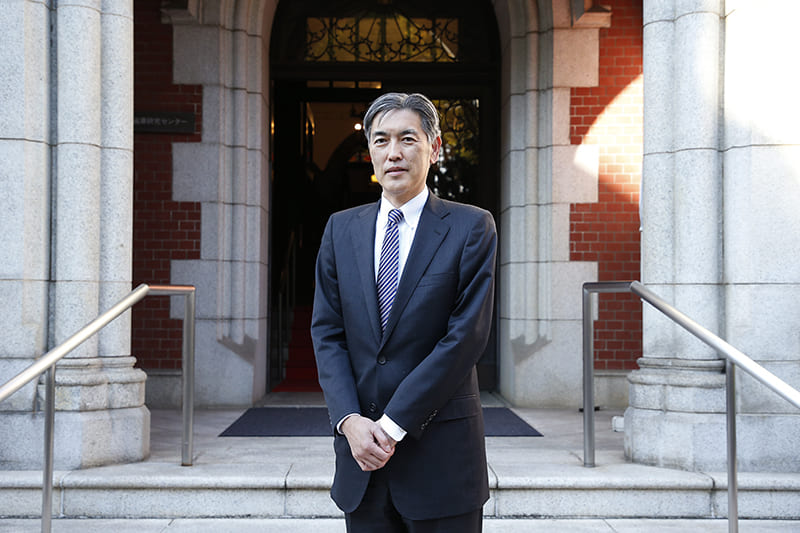
“As a member of the Toyota group, we have long been deeply involved in the automotive industry and have been engaged in businesses including renewable energy and automobile recycling for the past 40 to 50 years,” said Masashi Hirata, general manager of Toyota Tsusho’s Carbon Neutrality Promotion Department. “That’s why (our effort to achieve) carbon neutrality is an extension of what we had been doing. It doesn’t feel like a transition.”
In July 2021, the company took a significant step: It announced a “carbon neutrality declaration” and a mission of “passing on a better global environment to the children of the future.” Hirata said the company “regards carbon neutrality as presenting an opportunity for our business and the company to grow.”
Reflecting this, the declaration led to investments in what he called “aggressive business areas.” These include renewable energy, rechargeable batteries and hydrogen. While working to nurture sustainability-related businesses as a pillar of its growth strategy, Toyota Tsusho announced in April 2024 that it would withdraw from the thermal power business, which burned coal, heavy oil and liquefied natural gas. In July that year, it increased its target for investment in decarbonization-related businesses by 2030 to ¥2 trillion ($13 billion) from the initially targeted ¥1.6 trillion.
After Toshimitsu Imai was appointed as president and CEO in April 2025, its strategies became even more aggressive. In July that year, it obtained certification for its net-zero and near-term greenhouse gas reduction targets from the international Science Based Targets climate initiative. It was at this point that it took a step forward and set aggressive new targets of reducing Scope 3 emissions by 27.5% by 2030 and achieving net zero for all of Scopes 1, 2 and 3 — covering the entire value chain — by 2050.
Of Toyota Tsusho’s greenhouse gas emissions in the base year of 2019, Scope 1 and 2 direct and indirect emissions totaled about 800,000 tons, while its Scope 3 indirect emissions were about 150 million tons. Its business of energy-saving equipment, which has been a mainstay for the past 20 years, plays a key role in reducing these emissions.
For more than 20 years, its machinery division has provided customer plants with high-efficiency production equipment and energy management using storage batteries and has continued to propose ways to reduce emissions of carbon dioxide. This includes suppliers that are upstream of Toyota Tsusho and “has led to reductions in Category 1 of Scope 3 emissions,” according to Hirata.
Renewable energy
In addition, its renewable energy businesses, including solar and wind power, are growing rapidly. Believing that it can contribute significantly to helping decarbonize society as a whole, the company devotes as much as half of its decarbonization-related investment to the renewable energy business.
The centerpiece of this endeavor is the subsidiary Eurus Energy Holdings Corp. Eurus has participated in more than 180 projects in 18 countries and regions with renewable energy generation totaling some 5.15 gigawatts. The company continues to expand operations. In Japan, Eurus plans to build one of the nation’s largest onshore wind farms in Hokkaido.
Eurus is expanding its renewable energy business also in Africa, where Toyota Tsusho sells Toyota Motor vehicles. Through a joint venture with CFAO, another Toyota Tsusho subsidiary, Eurus plans to achieve a total output of 1 GW, equivalent to a nuclear power plant, by 2030 through equipment including solar power in Tunisia and wind power in Egypt. Worldwide, the company aims to achieve 10 GW by the same year.
50-year history in recycling
Fishing nets, automotive plastics, storage batteries … Toyota Tsusho’s circular economy business is another core segment that contributes significantly to reducing Scope 3 emissions. Its recycling business began in the 1970s when it started a business to properly process end-of-life vehicles.
“We sell Toyota cars in overseas markets,” said Junji Masuda, manager of the Corporate Planning Department’s sustainability management group, “and have served as not only the ‘artery’ function of supporting the production and distribution of mobility but also the “vein” function of taking on the collection of discarded vehicles and resource recycling.”
In July 2025, Toyota Tsusho announced that a recycled plastic made from automotive shredder residue by the affiliate K.K. Planic had been selected to be used in the front fender seal of the Crown Sport, the first Toyota car to get this treatment. The material is now also used in the RAV4 model.
Although Planic had already sold other recycled plastics to auto parts factories and makers of pallets and rainwater storage tanks, it has finally achieved car-to-car recycling. Waste plastics are difficult to sort. Planic introduced advanced gravity separation technology and equipment, used in Europe, for the first time in Japan to make car-to-car recycling possible.
As Toyota Tsusho aims to significantly scale up its resource recycling, from collecting waste to delivering recycled materials to manufacturers, it is also focusing on metals. In July 2025, it made Radius Recycling Inc., a leading metal recycler, a wholly owned subsidiary. The acquisition was valued at some $907 million, or about ¥134.4 billion at the time. Radius has more than 100 facilities, mainly in the United States and Canada, and processed about 660,000 end-of-life vehicles in fiscal 2024.
Toyota Tsusho’s carbon neutrality and circular economy services are two sides of the same coin, but there is also the “nature positive” aspect for the company to consider, about halting the loss of natural ecosystems and biodiversity, according to Hirata: “We had a heated debate about nature positive, and in our thinking, carbon neutrality … is the ideal state we should achieve and the circular economy is the means to achieve it.”
Toyota Tsusho is showing the way toward the evolution of the Japanese general trader business model itself. These days, there is talk of a return to fossil fuels and the difficulty of achieving carbon neutrality. Nevertheless, Hirata said, “We’ve been doing this for about 50 years, so even if others around us may appear likely to be swept away by the slightest change, we know we don’t have to follow suit.”