September 28, 2026
History of The Japan Times, part 1: The early years
130th anniversary series




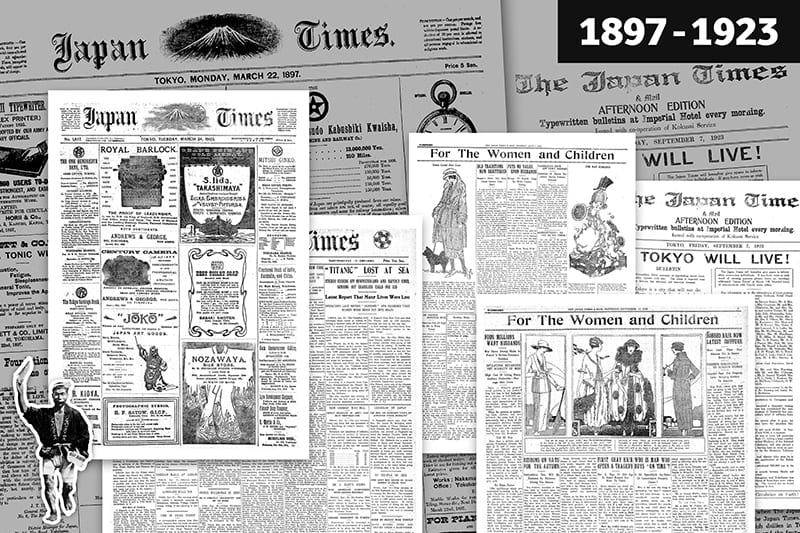
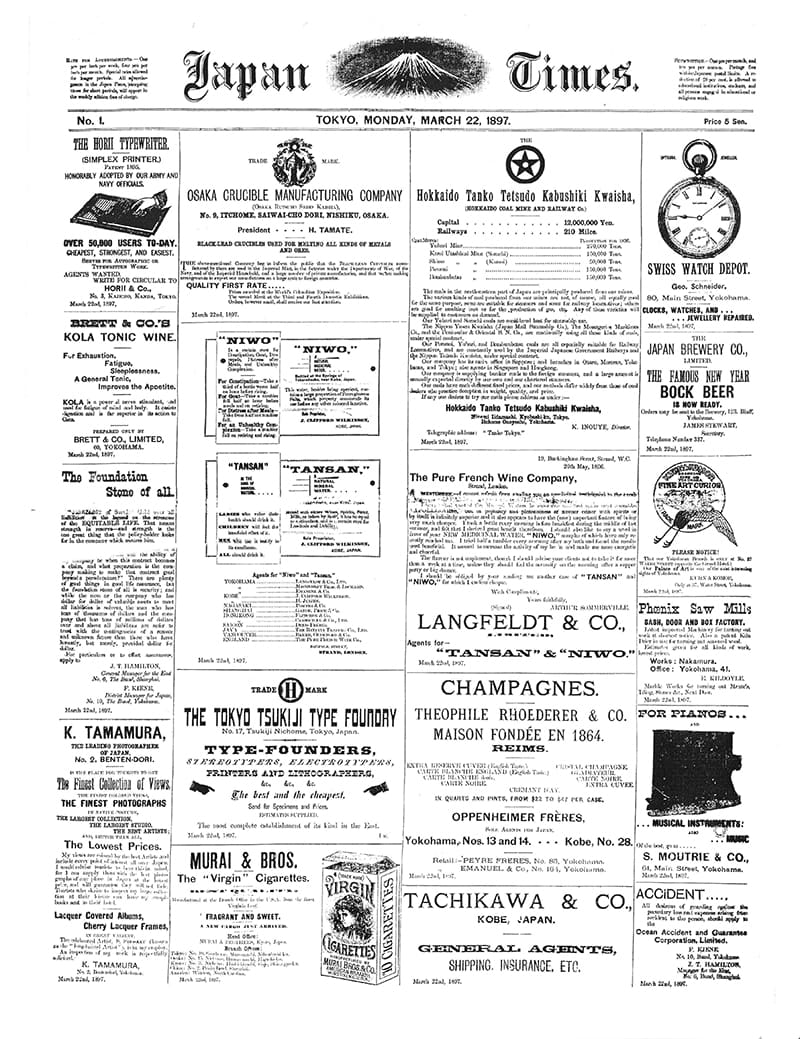
On Monday, March 22, 1897, readers of English-language newspapers in Japan discovered they had another choice as The Japan Times made its debut.
Founded by leading Japanese statesmen and intellectuals of the day, including the paper’s President Sueji Yamada and Editor-in-Chief Motosada Zumoto, a former executive secretary to Prime Minister Hirobumi Ito, its purpose was made clear in the inaugural editorial: The Japan Times was to be a bridge between Japanese and a foreign community largely concentrated in a few ports that operated outside Japanese law under an extraterritoriality system that was due to end in 1899, leading to much more daily interaction between them.
The risks for misunderstandings ranging from the harmless to the serious were manifest because the extraterritoriality system had kept foreigners and Japanese apart for nearly 40 years, meaning that “the bulk of the Japanese have as much difficulty to understand foreigners as the latter find it difficult to understand the former,” the editorial said.
Yet the more important barrier to mutual understanding, The Japan Times said, was language. Among the 5,000 non-Chinese residents at the time, the number with an intimate knowledge of Japanese language and literature “may be easily told, perhaps on the fingers of one hand,” the paper estimated. While knowledge of English was spreading quickly among Japanese people, “with some notable exceptions, the acquaintance of our countrymen with the English language and literature is in most cases superficial,” it added.
To bridge the divide — to increase understanding of Japanese politics, society and culture by communicating in English to the foreign community in Japan and to the outside world from a Japanese perspective — was thus the paper’s goal.
The Japan Times was not the first newspaper to undertake the task. Since at least 1861, various English-language daily and weekly newspapers run by Western publishers had served the Western merchants, missionaries, and consular officials and their families who resided in ports like Yokohama, Kobe, Nagasaki, Hakodate, Osaka, Tsukiji and Niigata. But it entered the market at a time when overseas demand for Japanese views, especially on events in Asia, was growing.
In the first few years after it launched, The Japan Times distinguished itself with reports about the country’s victory in the 1905-1906 Russo-Japanese War, which stunned the West and announced Japan was now a power to be reckoned with in East Asia. On May 20, 1905, the paper reported the Japanese Navy’s decisive victory over the Russian fleet in what history would call the Battle of Tsushima. “The combined fleet today met and gave battle to the enemy’s fleet in the vicinity of Okinoshima and defeated the enemy,” the paper said.
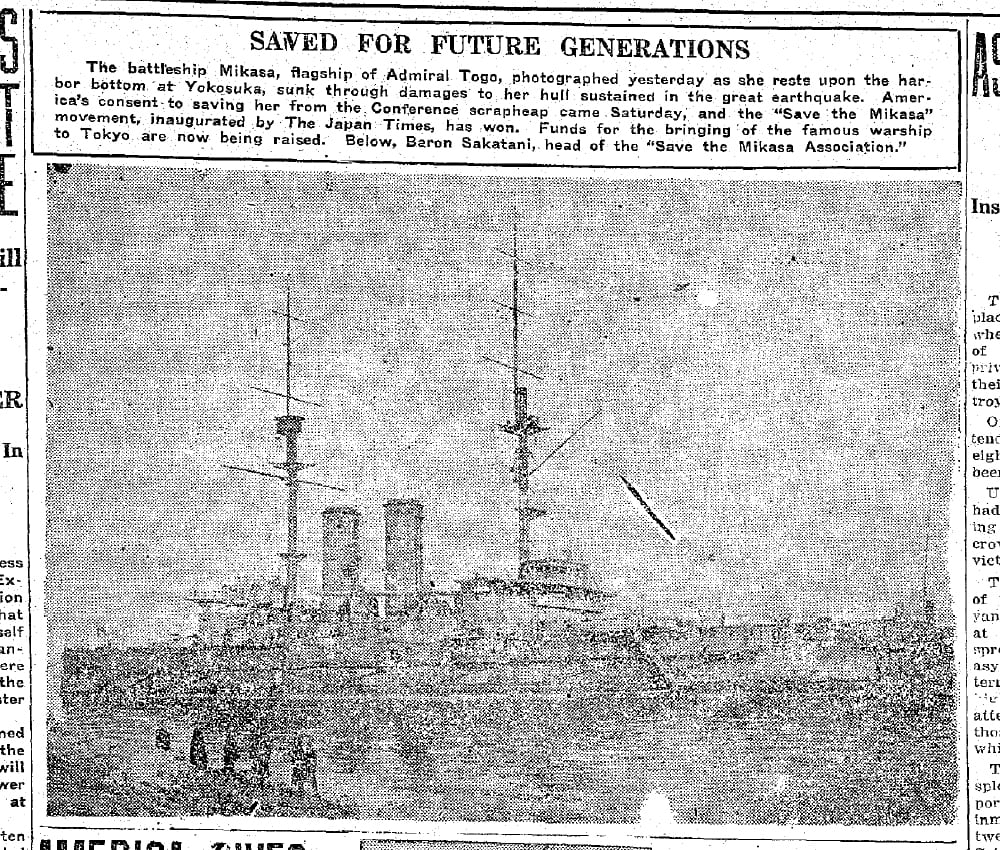
Decades later, The Japan Times would revisit the Russo-Japanese War in a very different manner, launching a public campaign to preserve the Mikasa, the flagship for Adm. Heihachiro Togo — one of the first campaigns of its type by any newspaper.
In August 1914, World War I broke out and Japan chose to side with the Triple Entente of France, the United Kingdom and Russia. Though it did not send troops to the Western Front, the Japanese military easily defeated German and Austrian forces at the German colony of Tsingtao, China.
By 1915, its combat role essentially over, Japan turned its attention to China. On June 10, when the U.K., France and Russia — all colonial powers in Asia — were busy fighting in Europe, the paper published the full official English translation regarding an agreement between China and Japan that gave Japan greater control over China after having annexed Korea in 1919, a situation that would lead to a much greater crisis in the decades after World War I ended in 1918.
While reporting at this time focused heavily on Japan’s growing role in East Asia and official political and economic views, The Japan Times also distinguished itself with detailed reports and explanations of all aspects of traditional and modern Japanese culture, aimed at foreigners who were arriving in increasing numbers to visit or live.
Western images of Japanese culture in the 19th century had painted Japan as a land of geisha, kimonos, cherry blossoms and samurai. Rudyard Kipling called Japan “a nation of artists.” But foreign writers had created an image of a strange, exotic country that Oscar Wilde said was “pure invention” by authors who often knew little about the context of whatever aspect of Japanese culture they were writing about.
The inaugural issue did not have much in the way of what would later be known as cultural news, but it did contain two book reviews: one on the history of Sapporo and another on a geographical study of Japan’s rivers, lakes and swamps. Five days later, readers were informed of a performance at Tokyo’s Kabukiza theater that would be of “great interest to foreign visitors,” and the paper slowly increased its reports on various aspects of traditional Japanese literature and theater, sometimes at great length.
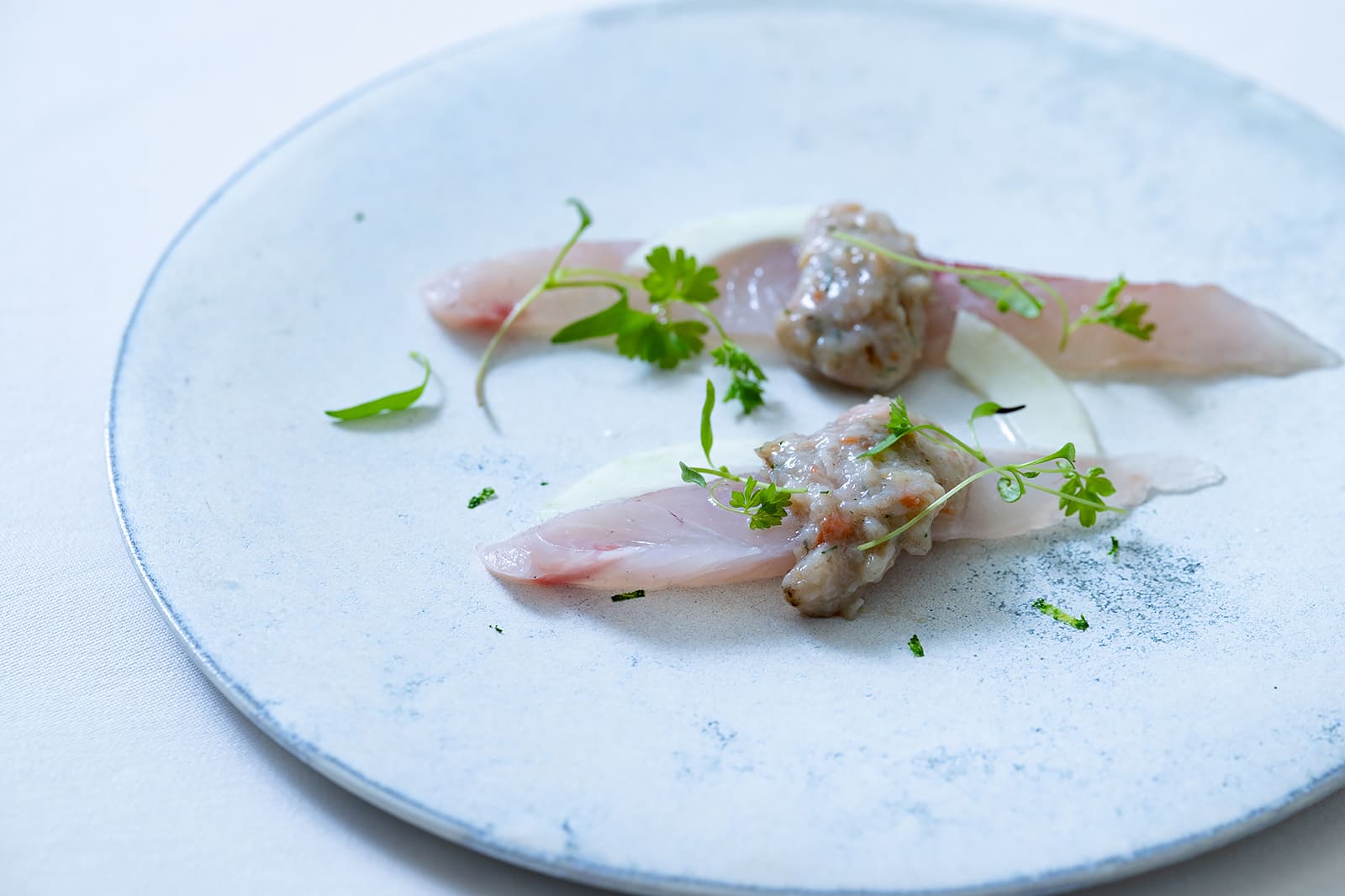
Culture would also include Japanese food culture abroad, which in one case was a brief mention in a type of chatty tidbit. On April 17, 1912, a Japan Times “special correspondent” in New York covered a March 16 dinner by the Japan Society for the newly arrived Japanese ambassador to the U.S. The piece mentioned that sashimi was served to the guests, perhaps one of the first times the dish was served in New York at what the writer said was the Japan Society’s largest dinner ever.
It was the kind of report on members of high society that all papers of the time, Japanese and Western, specialized in. Readers may have taken less note of the occasion than they would have otherwise, however, due to a story on the front page that same day: the RMS Titanic had struck an iceberg and was lost at sea.
With the end of World War I, peace returned and Japan entered the 1920s with a spirit of optimism in its industrial might and an expanding empire in East Asia. By 1923, The Japan Times was also optimistic about its own future, having proved that it had the ability to compete with the older English papers with detailed reporting on Japanese politics, economics, society and culture that equaled and often beat its competitors.
But it would take an earthquake that almost destroyed Tokyo later that year to show that the paper could also take on another role: that of a critical source of English-language information to its community of readers in time of disaster.
This article begins a four-part series commemorating The Japan Times’ 130th anniversary and exploring the history of Japan’s oldest English-language newspaper.