November 18, 2026
How Uchiko keeps or finds successors for farms


In Uchiko, the cultivation of various fruits, including grapes, kiwifruit, persimmons and pears, is thriving. According to Koya Sone from the town’s Agricultural Promotion Division, although highly profitable orchards tend to have successors, not all orchards can keep going. “Vegetable fields can be restored relatively easily, but once a fruit orchard is abandoned for even a year, it is extremely difficult to return it to a state where fruit of the original quality can grow. Repurposing the land for other uses requires an immense amount of time and effort for tasks such as pulling stumps,” Sone said.
In order to safeguard the future of its agriculture and ensure its sustainability, Uchiko has introduced initiatives to support new farmers. One provides an annual subsidy of ¥1.3 million ($8,200) for two years to farmers’ children or grandchildren if they or their spouses take up farming.
This program was established several years ago to address a structural gap in agricultural support. Various national and municipal programs assist new farmers, such as training subsidies, but public support has been sparse for young people continuing family farms. This initiative has already supported three individuals, ensuring the successful hand-over of agriculture to the next generation.
Uchiko has also introduced other original measures to support farming. The national government’s subsidy program for new farmers excludes applicants whose previous year’s household income exceeded ¥6 million. “However, when people leave their jobs and receive a retirement allowance, this often pushes their annual household income over the ¥6 million threshold,” Sone said. “Because of this, we have had cases where individuals who wanted to move to Uchiko and start farming ultimately had to give up their dreams.”
To address this issue, Uchiko has created a subsidy program for applicants age 49 or under who exceed the national income cap. Though the payout is lower than that of the national program, it provides subsidies over a two-year period during which participants undergo training with certified farmers in the town. One participant has completed this program and became an independent farmer in April, and another is in their second year of training. Notably, both moved from the Kanto region driven purely by a passion for agriculture.
While the national programs target only those age 49 or below, Uchiko also has established a subsidy program specifically for the 50-to-59 age bracket. Applicants cannot receive both municipal and national subsidies, but Sone noted that some applicants prefer Uchiko’s program to the national one: “Under the national program, training locations are restricted and trainees sometimes cannot find a farm cultivating the crops they want to grow. With our program, however, trainees can choose from more than 160 certified farmers in the town to be their trainer. This makes it much easier to find a farm that handles the exact crops they want to learn about.”
The town has also introduced a program that provides mentor farms with an annual subsidy of ¥300,000 for each trainee they accept. “This makes it easier to secure host farms and ensures they can provide a proper training environment,” Sone noted.
These measures are not based on what other municipalities are offering. They are the result of Uchiko’s efforts to find solutions to the problems it faces in preventing the decline of agriculture.
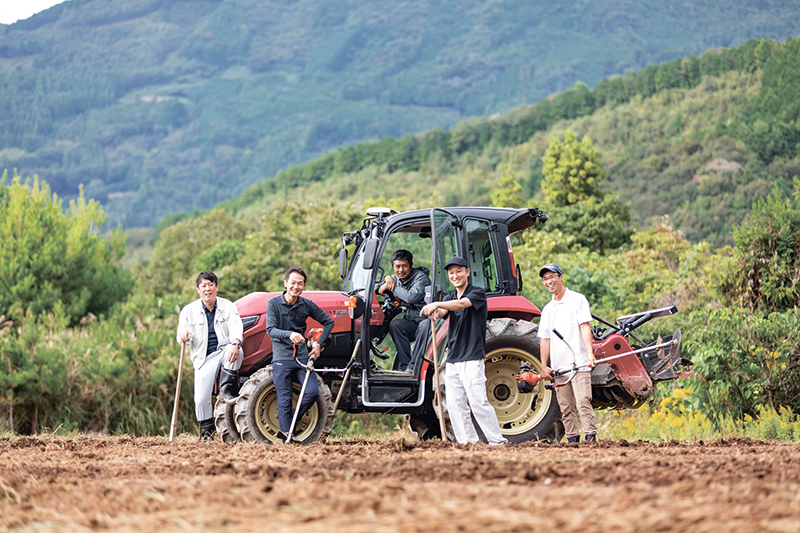
Young agricultural workers are also driving efforts to revitalize agriculture in the town. “A few years ago, an agricultural council consisting of young local farmers launched a project to regenerate idle farmland,” Sone said. “Through this project, they clear overgrown grass and remove brush from abandoned fields. They maintain these plots and introduce them to aspiring new farmers,” helping to safeguard the agricultural future of the town.
内子町、農業の担い手を守り、育てる取り組み
内子町では、ブドウやキウイフルーツ、柿、梨などの果樹栽培が盛んだ。町農林振興課の曽根航也氏によると、収益性の高い果樹園でも、必ずしも後継者が見つかるとは限らない。野菜畑は比較的容易に再生できるが、果樹園は1年放置しただけでも、従来と同じ品質の果実を生産できる状態に戻すのが難しい。ほかの用途に転用する場合も、木の根を取り除くなど、多大な労力が必要になるという。
町は農業の持続と次世代への継承に向け、独自の支援策を展開している。その一つが、農家の子や孫、またはその配偶者が就農する場合、年間130万円を2年間補助する制度だ。新規就農者向けの研修費補助などはある一方、家業を継ぐ若者への公的支援が手薄だったことから設けられ、これまでに3人が利用している。また、退職金などによって世帯所得が600万円を超えると国の新規就農支援を受けられない問題に対応し、所得制限を超える49歳以下の人を対象とした町独自の制度も導入した。さらに、国の制度では対象外となる50~59歳向けの支援も用意している。研修先は町内の認定農業者160人以上から選べるため、希望する作物を栽培する農家で学びやすい。研修生を受け入れる農家にも、1人当たり年間30万円を補助し、受け入れ体制の充実を図っている。
地元の若手農業者でつくる協議会も、耕作放棄地の草刈りや整備を行い、農地を新規就農希望者に紹介している。行政と地域の農業者が連携し、農地と農業の未来を次世代につなごうとしている。