June 01, 2026
Tottori Flower Garden opens at Japan health institute




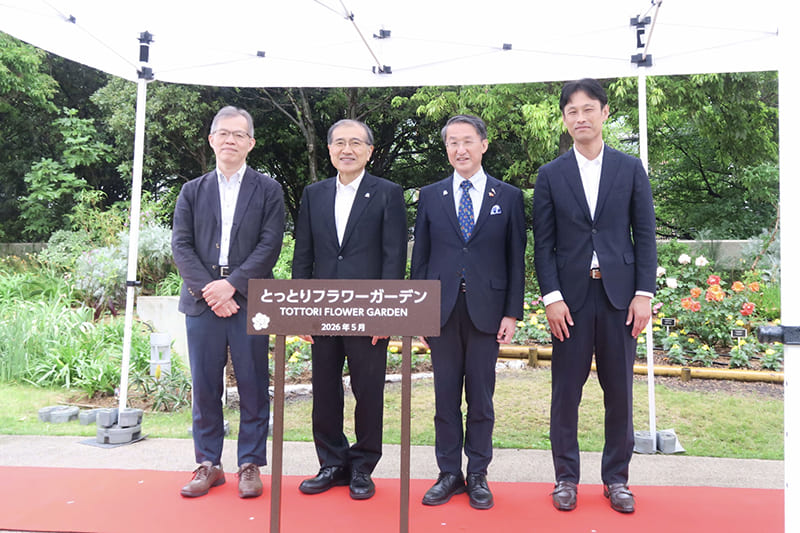
A new Tottori Flower Garden has opened within the International Garden of the Japan Institute for Health and Safety (JIHS) in Tokyo’s Shinjuku area.
An opening ceremony was held on May 21, with Tottori Gov. Shinji Hirai attending the launch of the showcase for the prefecture’s floral culture. The compact garden, modeled after Tottori Hanakairo, one of the region’s leading flower parks, brings a touch of Tottori’s rich natural beauty to the heart of the capital at a time of growing public interest in greenery and nature.
The initiative also marks the 61st Annual Conference of the Japanese Association of Botanical Gardens, held on May 26 in Yonago, Tottori Prefecture. The conference gathers professionals from across Japan to exchange views on garden management, plant research and other related topics. This year’s event was attended by Crown Prince Akishino, who serves as the association’s president. During his visit, he toured Tottori Hanakairo.
JIHS was launched in April 2025 through the integration of the National Center for Global Health and Medicine and the National Institute of Infectious Diseases. The new organization plays a central role in Japan’s response to health crises, providing scientific advice to the government while overseeing research, data analysis, crisis response, human resource development, international cooperation and medical services. Hirai, who served as a coordinating figure for the National Governors’ Association during the COVID-19 pandemic and contributed to national-level policy discussions, now sits on the JIHS board as an external director. His involvement helped pave the way for the creation of the garden.
Hirai expressed his hopes for the project, saying, “We want people across the country to experience the flowers and plants of Tottori Hanakairo.” He said the garden is part of a broader effort to share Tottori’s floral richness nationwide, adding that its location at JIHS provides a rare chance to reach people in medical and research fields. “I hope this space will provide comfort to patients, researchers and everyone who visits,” he said.
Although the garden covers only about 10 square meters, it condenses the essence of Tottori Hanakairo into a vibrant display. Volunteers help maintain flowers like lilies, marigolds, begonias and roses associated with the imperial family, creating a colorful landscape that evokes Tottori’s natural scenery. “Every flower has its own story and character,” said Kosuke Yamaguchi, director of Tottori Hanakairo, who attended the ceremony. “I hope visitors will enjoy not only the beauty but also the background behind each plant. And if this garden inspires people to visit Tottori itself, we would be delighted.”
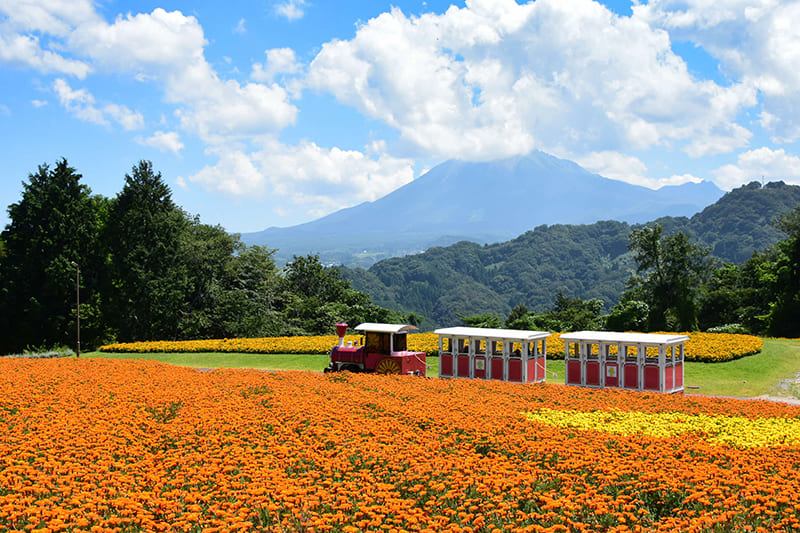
Tottori Hanakairo opened in 1999 and spans an area equivalent to 11 Tokyo Domes. Situated at the foot of Mount Daisen, the highest peak in the Chugoku region, the park is renowned for its lush natural surroundings and seasonal floral displays. It features a large dome that allows visitors to enjoy flowering plants year-round, expansive flower fields, a circular corridor and dedicated seasonal exhibition zones. Tulips in spring, lilies in summer, salvias in autumn and winter illuminations create an ever-changing landscape. Thanks to its convenient access — about a 25-minute ride on a free shuttle bus from Yonago Station — the park attracts visitors from across Japan.
One of the park’s defining features is its commitment to maintaining a landscape where flowers are always in bloom. Annuals such as marigolds and begonias are replaced as needed, with approximately 400,000 plants used each year. The park also employs a unique technique to control the blooming period of lilies, its signature flower. By freezing the bulbs to induce dormancy and then storing them at 2 degrees Celsius, staffers can adjust blooming times and ensure year-round displays. This level of control is rare among Japanese botanical facilities and is a hallmark of Tottori Hanakairo.
Looking ahead, the Tottori Flower Garden is expected to serve as a key base for sharing information about the prefecture’s floral industry in the Tokyo metropolitan area. In addition to hosting events related to flowers and greenery and supporting tourism promotion, the garden will also be used as a platform for outreach leading up to Green×Expo 2027, an international horticultural exhibition in Yokohama.
Interest in nature and greenery has been growing in urban areas in recent years, and spending time around flowers and plants has increasingly become a source of comfort and relaxation for many people. The Tottori Flower Garden is expected to serve not only as a place for Tokyo residents to experience Tottori’s natural beauty and floral culture, but also as a space that encourages people to rediscover the value of flowers and greenery.