August 17, 2026
Hankyu Hanshin Holdings builds sustainable communities for life
Sustainable Japan Award: ESG Grand Prize




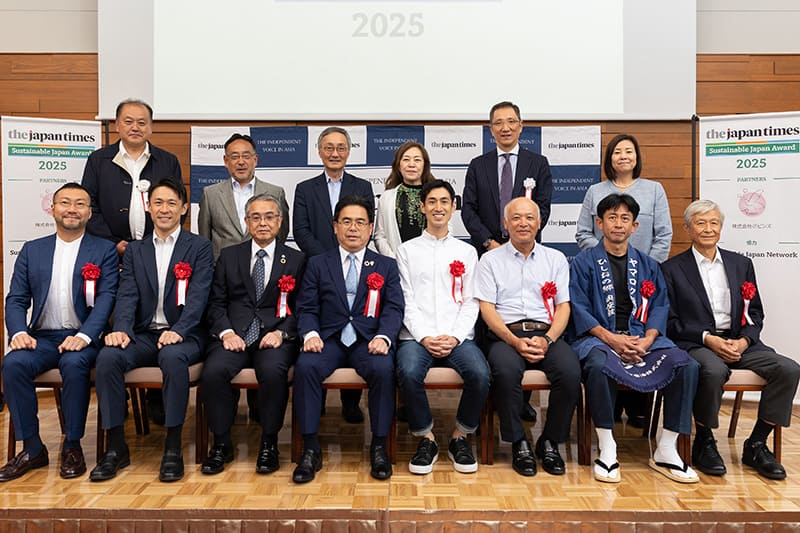
Building on its railway operations, Hankyu Hanshin Holdings has grown into a diversified corporate group with operations spanning real estate, commercial facilities, entertainment and many other fields. Its entertainment businesses include the Hanshin Tigers professional baseball team and the Takarazuka Revue. The group, which generates annual revenue of approximately ¥1 trillion ($6 billion), received the Grand Prize in the ESG category of the Sustainable Japan Award 2025 for its long-standing commitment to community development and sustainability.
The group’s approach to community-building is rooted in the vision of its founder, Ichizo Kobayashi. Rather than simply operating a railway, he pioneered an integrated model that combined rail transportation with housing, commercial and cultural developments to create communities where people would want to live. More than a century later, that philosophy remains at the heart of the group’s business.
“We built communities in places that were once sparsely populated,” said Yukiko Sagara, general manager of the Corporate Sustainability Department at Hankyu Hanshin Holdings. “Our mission is to work alongside local governments and communities to create places where people genuinely want to live.”
Guided by its corporate philosophy — “By delivering ‘Safety and Comfort’ and ‘Dreams and Excitement,’ we create satisfaction among our customers and contribute to society” — the group has evolved its community-building philosophy into a broader sustainability strategy.
Putting that philosophy into practice, the group launched the Hankyu Hanshin Mirai no Yume Machi Project in 2009. Aiming to create communities where people would choose to live for generations to come, the initiative carries out around 100 projects each year focused on conserving the natural and cultural environments along its railway lines and nurturing the next generation.
To mark the project’s 10th anniversary, the group introduced the SDGs Train in 2019, featuring interiors and exteriors designed around the U.N.’s sustainable development goals. The following year, in partnership with Tokyu Corp., similar trains powered by virtually 100% renewable energy began operating in both the Kansai and Tokyo metropolitan areas.
Building on these initiatives, the group adopted its Sustainability Declaration in 2020, positioning decarbonization and environmentally responsible urban development at the core of its management strategy. “Our goal is to create a society where everyone can enjoy fulfilling lives, now and in the future, and where making sustainable choices becomes second nature,” Sagara said.
The group became the first railway operator in the Kansai region to achieve carbon-neutral operations across its entire Hankyu and Hanshin rail networks in April 2025 as electricity used for train operations and station facilities was switched to virtually 100% renewable energy. The group also partnered with municipalities and other organizations to establish Kansai Machi We’ll, a regional consortium dedicated to promoting decarbonization.
The group is advancing initiatives to improve energy efficiency and accelerate decarbonization across the communities it serves. Corporate power purchase agreements (PPAs) have been introduced for major facilities, including Hanshin Koshien Stadium and the Takarazuka Grand Theater, expanding the use of renewable energy across its operations.
Its Zero Carbon Baseball Park, home to the Hanshin Tigers’ minor league team, became Japan’s first baseball stadium to receive ZEB (net-zero-energy building) certification and was selected as one of the Ministry of the Environment’s inaugural Decarbonization Leading Areas, highlighting the group’s commitment to low-carbon urban development.
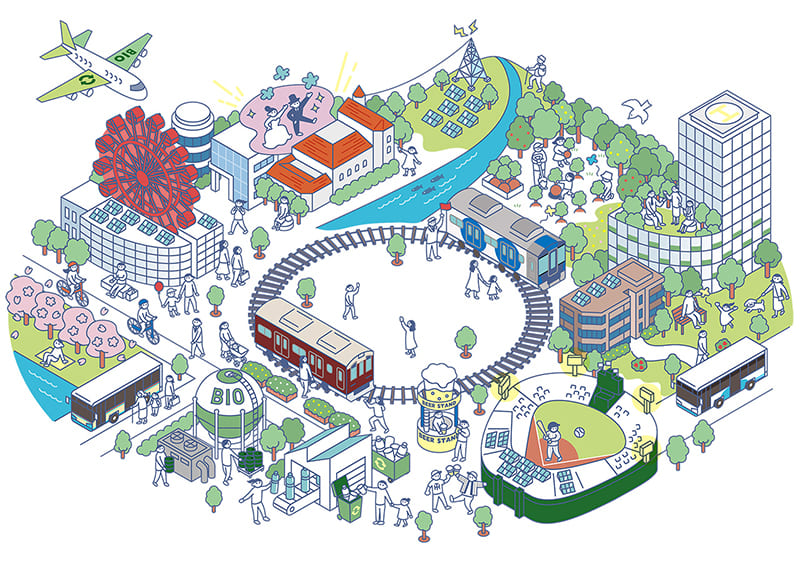
The group has also integrated nature conservation into its urban development strategy. In Osaka’s Umeda district, the group’s largest development area, the group is advancing urban redevelopment alongside biodiversity conservation. At Osaka Umeda Twin Towers South, opened in 2022, rooftop and vertical greenery planted with native tree species from the Rokko mountain range and the Yodo River basin has created habitats for birds, insects and other wildlife. The project has been certified by the Ministry of the Environment as a Nationally Certified Sustainably Managed Natural Site.
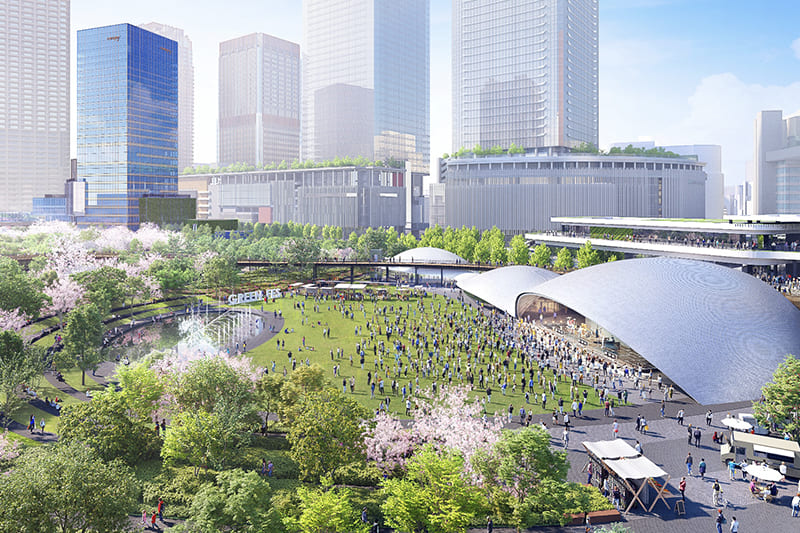
The group’s commitment to nature-positive development is also evident in its participation in Grand Green Osaka, where more than 1,600 trees have been planted across 45,000 square meters of green space. The project blends nature with urban life, promoting well-being through innovative area management.
These long-standing initiatives have since been brought together under the group’s long-term management strategy, which defines three environmental outcomes it aims to achieve: decarbonizing society beyond its own operations and supply chain, enhancing urban attractiveness and well-being through greening and nature conservation, and promoting a circular economy through waste reduction and recycling. Each outcome is supported by clearly defined key performance indicators (KPIs) to track progress.
More than a century after it began, the group’s vision for community-building continues to evolve. By bringing together a wide range of partners, Hankyu Hanshin Holdings helps create communities where making sustainable choices becomes second nature — demonstrating that environmental responsibility and vibrant urban living can go hand in hand.