October 13, 2026
Mizuho deploys ¥100 trillion to create a better future





Mizuho’s strong points
1.Quadrupled sustainable finance target to ¥100 trillion; ¥51 trillion already executed
2.Helps hard-to-abate sectors decarbonize
3.Developed proprietary “avoided emissions” and “natural capital management” indicators, expanding the scope of their application to areas outside decarbonization
4.Goes beyond the usual role of a bank to help develop circular economy-oriented industries by connecting businesses across different industries
Mizuho Financial Group Inc., one of Japan’s three megabanks, made a surprising announcement in April 2023, quadrupling its target for sustainable finance from fiscal years 2019 through 2030 to ¥100 trillion (currently $630 billion).
That 12-year total comes close to Japan’s entire initial general account budget for fiscal 2025. And the bank has been on track so far: By fiscal 2025, it had exceeded half of the target amount, executing ¥51 trillion in financing.
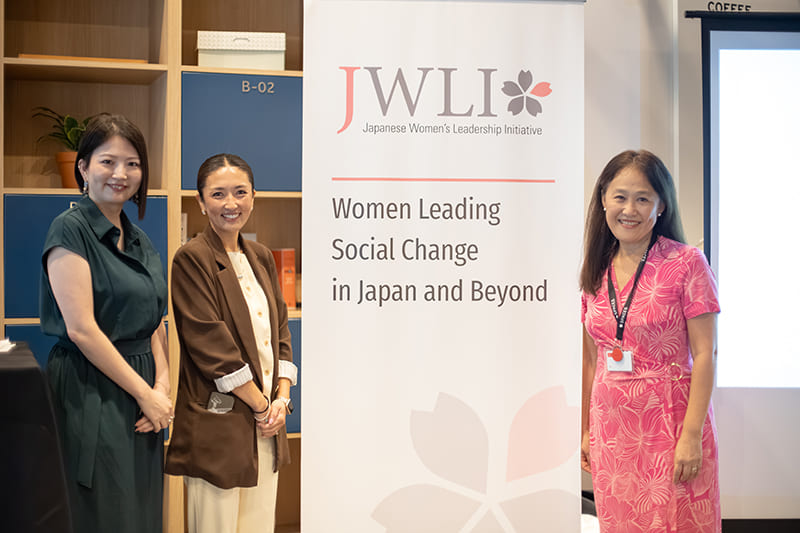
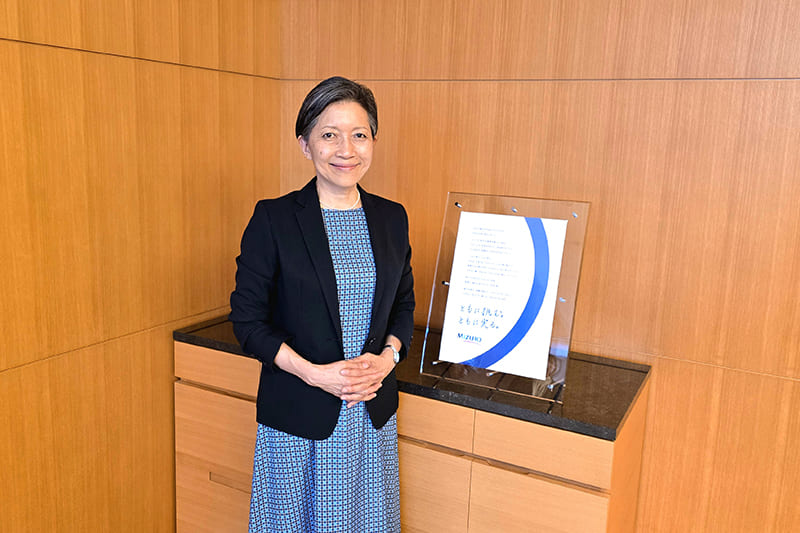
“This bank is serious about shaping the future with clients,” said Megumi Muto, a senior managing executive officer and deputy group chief sustainability officer at Mizuho, which she joined in April 2025 after working for the Japan Bank for International Cooperation and then serving as chief sustainability officer at the Japan International Cooperation Agency.
“I really think Mizuho has a strong desire to … go beyond merely providing financial services.”
And Mizuho is determined to to future-proof Japan’s industrial structure itself. The ¥100 trillion target is just the start.
Working with high emitters
In March 2021, Mizuho Bank executed a transition loan totaling some ¥5.9 billion to the shipping company Kawasaki Kisen Kaisha Ltd. to finance decarbonization initiatives — the first such loan in Japan.
That September, Mizuho Bank also led Japan’s first loan linking the borrower’s progress toward its decarbonization target to terms of the loan, such as borrowing rates, to Kawasaki Kisen.
Mizuho Bank has since continued to support decarbonization efforts of hard-to-abate sectors such as the steelmaker JFE Holdings Inc. These efforts all contribute to bringing Mizuho closer to the ¥100 trillion target.
Explaining why Mizuho continues to provide funds to hard-to-abate sectors, Muto said: “Because it’s a matter that affects our customers’ long-term business continuity. And survival of our customers is a matter of our own survival.”
The more hard-to-abate a sector is, the more difficult decarbonizing is. And lending to a hard-to-abate sector entails greater risk for Mizuho. That is why Mizuho has attached importance to engaging with its borrowers, according to Muto.
“We work with our customers to paint a vision for their future and then ‘backcast’ from there and work with them to determine what kind of investments and governance reforms they need,” she said.
In both fiscal years 2024 and 2025, Mizuho engaged in dialogue with about 100 key customers for which it had set targets for reducing Scope 3 indirect emissions and confirmed the progress of measures taken by about 550 companies that were exposed to transition risk.
Discernment and standards
Mizuho has other tools as well: its capabilities for discernment and the standards it applies by mobilizing its broad knowledge of industry research.
“Mizuho goes all out to do industry research, as it always has,” said Muto. Mizuho thoroughly researches an industry before looking into a company’s finances. The knowledge accumulated from this has sharpened its ability to evaluate new technologies and companies and has also helped it develop unique evaluation criteria.
Mizuho is also committed to helping its existing corporate customers decarbonize by helping them identify necessary technologies and providing support to them.
In 2022, Mizuho Bank introduced a “transition investment facility” targeting seed-stage decarbonization technologies, aiming to invest at least ¥50 billion over 10 years. In the first deal for the facility, the bank invested ¥300 million in Synplogen Co., a startup for DNA synthesis technology founded by Kobe University researchers. Mizuho also helps incentivize the scaling of technologies necessary for decarbonization.
Even if a company’s greenhouse gas emissions rise as it increases production, those products may result in lower overall emissions in the end. In light of this, Mizuho has started to use the indicator “avoided emissions,” which measures the amount of greenhouse gas emissions avoided by society as a whole.
One example of this is Mizuho Avoided Emissions Impact Finance, the first financial product in Japan to incorporate avoided emissions. Mizuho launched it in October 2025 and has already executed loans to Kawasaki Heavy Industries Ltd. and the electrical equipment maker Meidensha Corp.
Finance to change society
Mizuho has also begun to pay attention to “natural capital,” which involves a complex interplay of water, biodiversity, land, ecosystems and other factors.
Mizuho launched Mizuho Natural Capital Impact Finance, which uses a proprietary evaluation method, in February 2025. This financial product evaluates and provides financing for “nature-positive” management practices aimed at restoring natural capital. It has already been applied in five instances, one of which was a ¥34 billion loan in March 2025 to Oji Holdings Corp. by a syndicate comprising 23 financial institutions in Japan, with Mizuho Bank serving as the arranger.
In the area of the circular economy, a group of eight companies led by Mizuho Bank announced this March that they had conducted joint research aimed at establishing a chemical recycling chain for plastics. The project aims to recycle plastic waste in Kyushu, where automobile-related industries are concentrated, and supply the recycled material back to the industry.
The group includes the trading companies belonging to the three largest automotive groups in Japan: Toyota Tsusho Corp., Nissan Trading Co. and Honda Trading Corp. “It’s difficult for companies in the same industry to work things out together when they try to do it themselves,” Muto said, “but when a bank gets involved, everyone agrees to work together.”
In April, Mizuho started a joint research project with three partners, including Ishizaka Group, to recycle high-quality waste plastics from the semiconductor industry in Kyushu into materials for use in automobiles, a process known as “X to Car.”
These initiatives are partly aimed at addressing stricter environmental regulations in Europe. Mizuho acts as the organizer, playing the role of planning and implementation, which includes connecting upstream and downstream players in resource circulation, regional stakeholders, and even competing companies. What enables Mizuho to play this role is the expertise and discernment it has developed over the years, as well as its broad customer base.
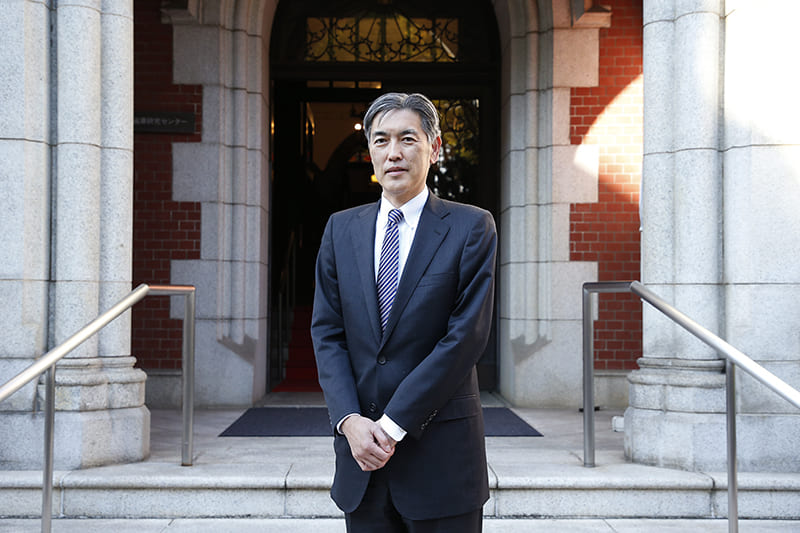
Mizuho has now gone beyond the usual realms of a financial institution and has begun to play the role of helping industries transform — and even society as a whole. “When we’re having a discussion among ourselves, we often find ourselves speaking sentences that have the whole of the country” as the subject,” said Takayuki Koyama, who serves as director at Mizuho Bank’s Sustainable Business Promotion Department.
Muto chimed in: “That’s true! When I switched from my public sector job in the government, I thought things would be quite different (in a private company), but it turned out to be just the same. Mizuho has a whole-of-country approach, in a constant pursuit of balancing between the environment, the economy and society!” she added.