January 19, 2026
New Logistics Consortium baton to accelerate trucking efficiency




Japan’s logistics industry is facing pressing challenges, including accelerating labor shortages and increasing need for addressing environmental issues. According to a report compiled by the Ministry of Economy, Trade and Industry in February 2023, if no countermeasures are taken, there could be a 34.1% shortfall in transportation capacity (equivalent to 940 million tons) by 2030.
The Ministry of Land, Infrastructure, Transport and Tourism issued guidelines to address these challenges in the “Comprehensive Logistics Policy Outline” for fiscal years 2021 to 2025, approved by the cabinet in June 2021. These guidelines cover supply chain optimization, countermeasures against labor shortages, structural reform of logistics and the establishment of a resilient and sustainable logistics network.
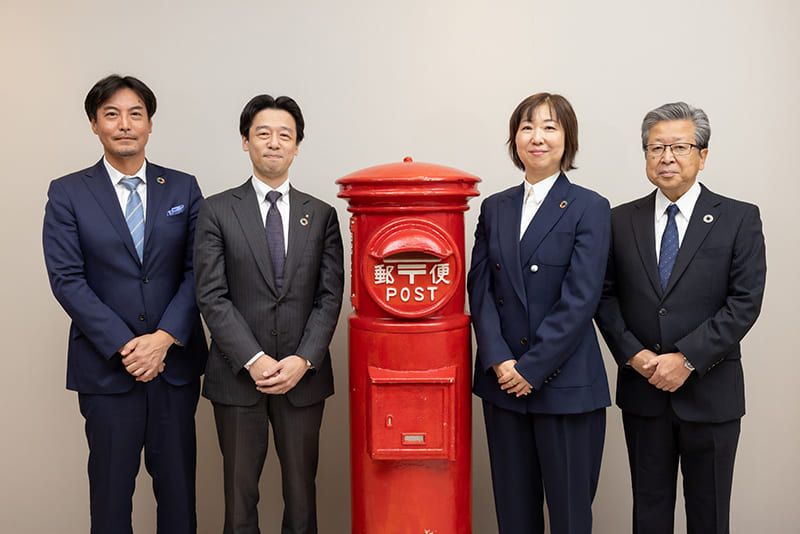
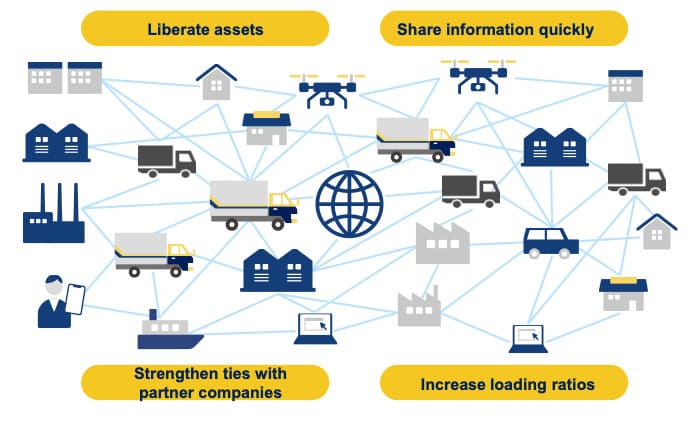
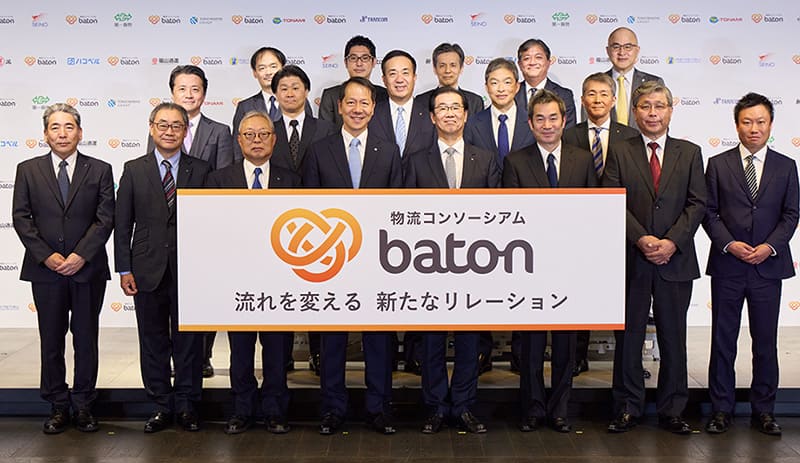
To accelerate concrete initiatives following these guidelines, the Logistics Consortium baton was established in November 2024 by 11 companies such as Seino Holdings Co. Ltd., a top transportation company and longtime member of The Japan Times Sustainable Network, insurance firms such as Tokio Marine Holdings Inc. and others. Its primary aim is to implement the pooling of resources through “multi-carrier relay transportation.”
The consortium’s initial two-month pilot project, starting next month, is the driver-change model, in which drivers will take turns transporting goods over a single route. This should improve their working conditions and boost productivity by giving them shorter hours.
Prior to the project, the consortium first aggregated and analyzed data on 13,000 shipments operated by participating carriers — a first-of-its-kind initiative in Japan. By evaluating transportation routes, load ratios, operating hours and schedules, they identified trunk routes where relay transportation could improve efficiency. Discussions have also been held on how to create risk-sharing frameworks in the event of accidents and how to standardize operational processes.
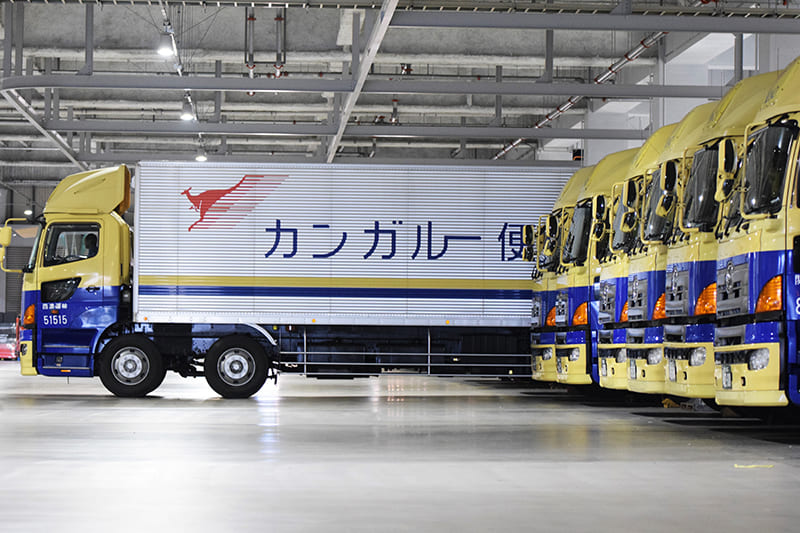
Seino, headquartered in Gifu and in the logistics business for over 90 years, is an industry leader in sustainability and introduced relay transportation for some trunk routes ahead of the launch of the consortium. This allowed Seino to provide insights that helped identify operational challenges.
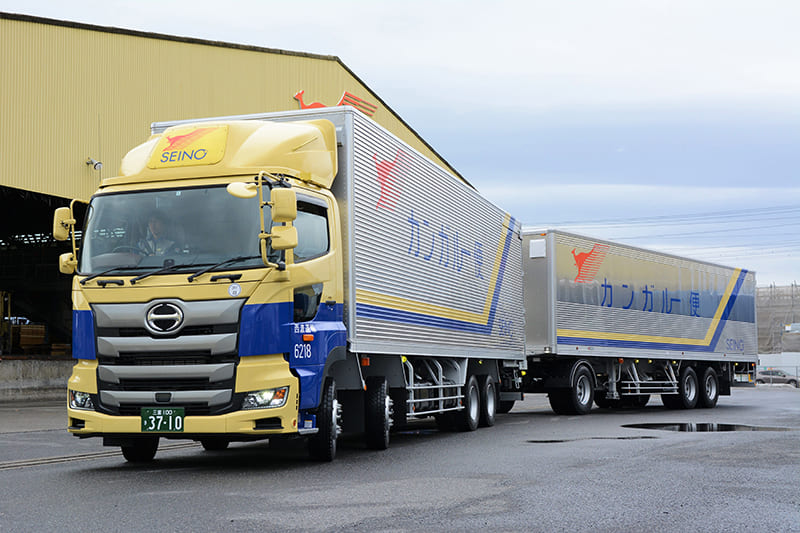
Seino has been making various efforts to reduce emissions of carbon dioxide, including the introduction of two trucks hooked together, a shift from diesel to electric, training drivers on energy-saving driving skills and adopting reusable pallets and packing materials. It has also been collaborating with other freight companies in initiatives to save on energy and workloads and believes the consortium will further expand cooperative relationships that enhance each other’s efficiency.
As part of baton’s first pilot project, Seino will collaborate with Fukuyama Transporting Co. Ltd. on relay transportation between Fujisawa in Kanagawa Prefecture and Sakai in Osaka Prefecture. Meitetsu Transportation Co. Ltd. and Tonami Transportation Co. Ltd. will handle another route, between Higashi Osaka and Kasai in Tokyo, by relay transportation.
Through this project, baton will evaluate the handover of trucks and handling of cargo at driver changeover points and will also examine driver movements between changeover points, responses to irregularities such as delays and the need for parking arrangements.
After the project is completed and reviewed, baton plans to expand the relay network, create a common database for its operations and develop applications for operators and algorithms to combine services.
However, Seino, based on its preexisting experience and expertise in relay transportation, believes that achieving higher efficiency in logistics in a true sense requires the cooperation of a greater number of diverse stakeholders to achieve smoother and safer operations, enhance safety, develop and maintain relay hubs and systems to manage the entire operation, and manage health and labor issues. To create a holistic framework that covers all these elements, it is necessary to gather companies specialized in each field, and the consortium is considering the phased expansion of participating companies.
Already, not only logistics operators but also logistics facility operators and developers, IT companies, health care service providers and leasing companies have shown interest in the initiative, and discussions have begun for future collaborations.