July 27, 2026
Dassault Systemes drives broad business innovations
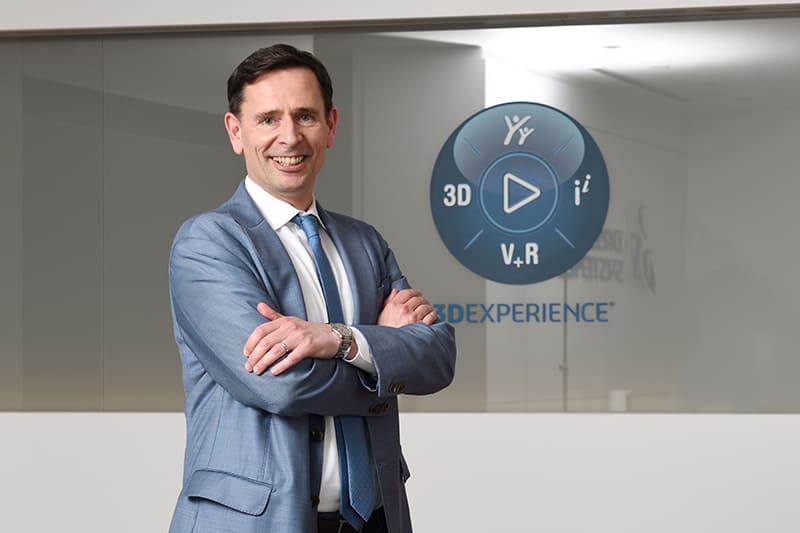
Sebastien Cardet helps clients make ideas real with ‘virtual twins’
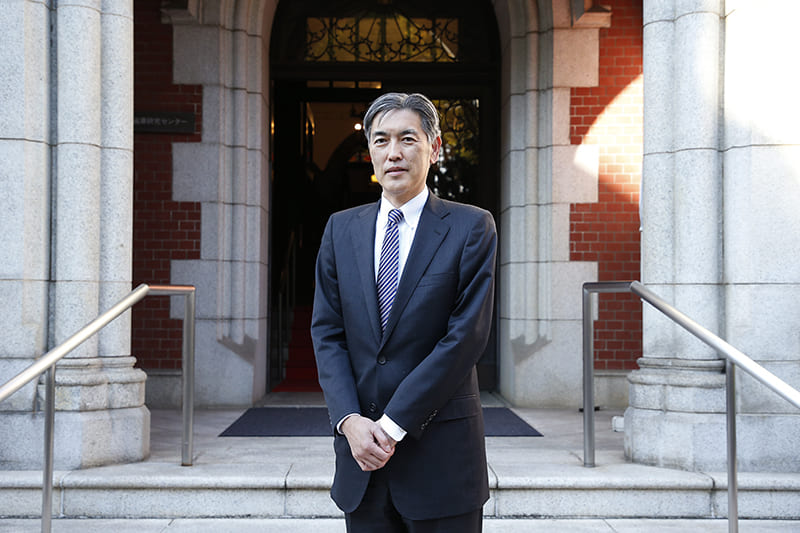
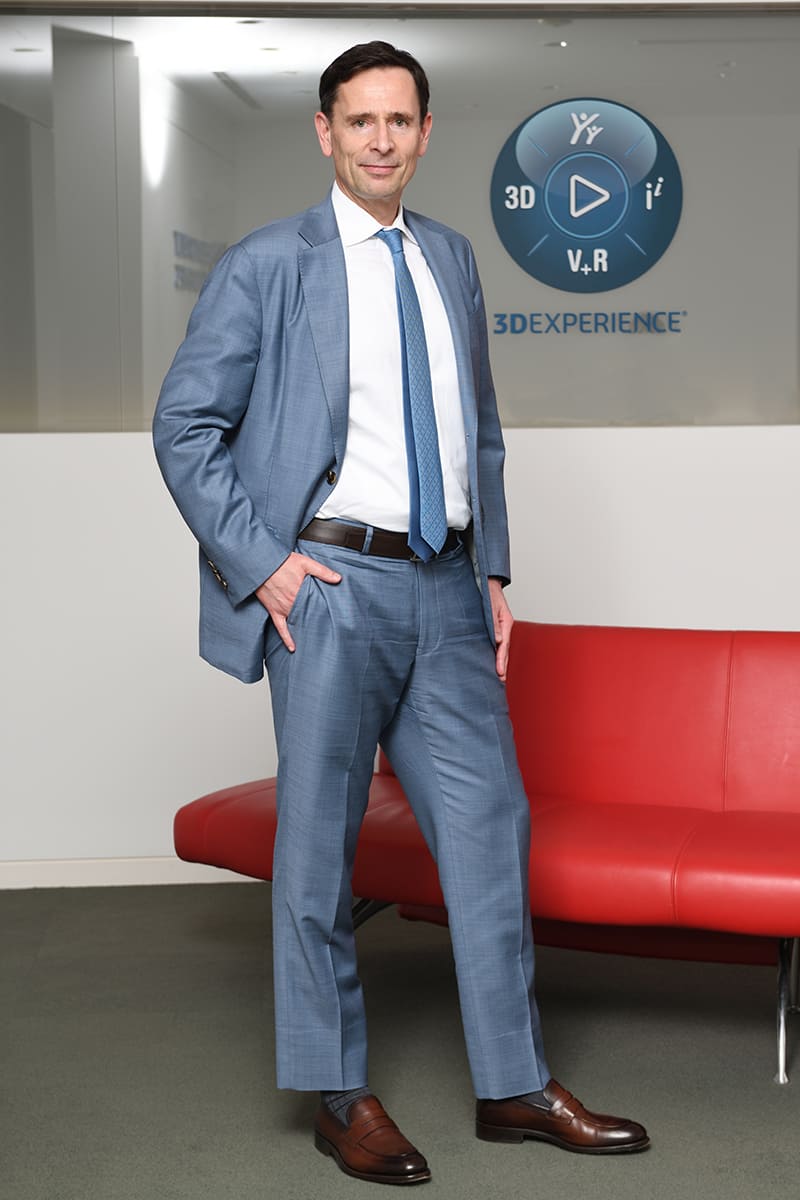
- Name: Sebastien Cardet
- Title: Vice President of Consulting & Services Japan, Dassault Systemes
- URL: https://www.3ds.com/
- Hometown: Giverny, France
- Years in Japan: 18
Headquartered in France, Dassault Systemes is a multinational technology company that helps its clients transform ideas into reality through “virtual twins” — digital models and simulations that enable testing before real-world implementation. Transformation is also a recurring theme for Sebastien Cardet, the vice president of consulting and services in Japan. Reflecting on nearly two decades in Japan, he shared insights into the changes he has witnessed in Japanese business culture, as well as how his experiences in Japan have shaped his own path.
Looking beyond technology
Dassault Systemes works with leading Japanese companies across industries ranging from automotive and aerospace to consumer goods, infrastructure and cities, energy and life sciences. The firm creates virtual representations of products, factories and even entire value chains, ensuring clients’ designs and processes can be tested and optimized before anything is built.
Because virtual twins must be tailored specifically to each customer’s business, consulting is a crucial part of Cardet’s work, allowing companies to innovate in more sustainable and efficient ways. “We help customers improve their innovation processes by combining engineering excellence, data and artificial intelligence so they can remain competitive in their markets,” he said.
Cardet joined Dassault Systemes in 2001 as an engineer in the R&D department. While the technology available at the time was vastly different from what his team has at its disposal today, lessons learned in those early years laid the foundation for his career. He quickly realized that technology alone was not enough to help customers succeed.
“I didn’t want to be simply a technical expert who knew how to create virtual twins perfectly,” he explained. “I wanted to understand how our customers work, what their challenges are and how I can help them get the most out of our technology.”
Cardet’s career progressed steadily, but as he approached his 30s, he began wondering what fresh challenges lay beyond Europe. While he initially hoped for a transfer to the United States, in 2008 an opportunity arose to move to Japan.
His subsequent 18 years in Japan have been fruitful ones, and he has seen the company’s operations grow from around 80 employees to almost 1,000. He has also built a family with his Japanese wife, and the couple will welcome their second child later this year.

A long-term commitment
Japan holds a significant place in the Dassault Systemes story. Just a year after the company was founded in France in 1981, Soichiro Honda, the eponymous founder of Honda Motor Co., reached out to the company. This led to Japan becoming Dassault Systemes’ second market — one that remains important today.
Cardet’s relocation coincided with the company’s expansion in Asia, and he was entrusted with leading the Asia-Pacific region from Tokyo. “I liked the idea of being quite far from my comfort zone — and I wasn’t disappointed!” he quipped.
Although he didn’t fully understand the tenets of Japanese business culture at first, he soon came to realize that many aspects aligned closely with his own core beliefs. “There is a very deep focus on creating high-quality products and services, and I don’t think you can find that anywhere else in the world.”
Along with Japan’s technological excellence, Cardet was impressed by the long-term commitment to relationships and the resulting trust between business partners. These aspects are a large part of why he has chosen to remain in Japan. “Of course, I’m French and I still love France,” he said. “But when I think about what I value most in life and in my professional career — respect, discipline and quality — I find those qualities in Japan.”
He believes that many international companies have struggled in Japan because they expected to quickly become profitable without investing time in building relationships. In his experience, trust is earned through reliability, consistency and genuine engagement. Companies that adopt this long-term mindset are usually more successful in Japan than those focused on short-term gains.
Transforming the future
Dassault Systemes’ consulting team in Japan began with just four people in 2008 but has now grown to more than 350 professionals. Looking back over his time in Japan, Cardet is struck by how much the business culture has changed. While Japanese firms had been expanding overseas for decades, he noticed a shift from around 2010 as many leading companies began to recognize that international success required a different mindset.
“They still need, of course, to leverage their strengths,” he said. “However, they also need to embrace diversity, accelerate the decision-making process and adopt the local culture.” To this end, globalization is not just a matter of business intelligence, it’s a matter of cultural intelligence, too.
As part of this approach, Cardet says, diversity, equity and inclusion (DEI) is a “business imperative.” Today’s products and technologies are increasingly complex and ultimately used by people with a wide range of needs, so companies must bring together diverse perspectives to design and develop them effectively.
He points out that internal metrics consistently show that proposals developed by teams with a broad range of backgrounds are more successful than those created by groups with similar outlooks. “What we need is diversity of opinion to build a kind of 360-degree proposal that makes sense for all the people we are going to serve.”
While many companies assume successful transformation requires adding new organizational layers or processes, Cardet believes the opposite is true: Meaningful change comes from simplifying organizations and removing unnecessary layers, allowing people to focus on the activities that truly create the most value.
In line with this, Cardet finds inspiration in the words of French writer and aviator Antoine de Saint-Exupery (1900-1944). “In his book ‘Terre des hommes,’ de Saint-Exupery wrote that ‘Perfection is achieved not when there is nothing more to add, but when there is nothing left to take away,’” he said.