November 24, 2026
Event explores pairing sake with cheese, global dishes
Media partner


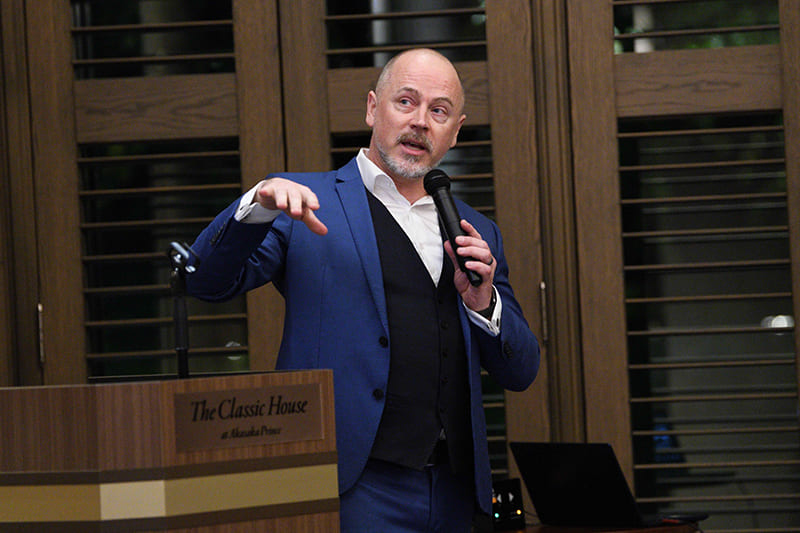
Japanese sake, whose traditional brewing methods have been registered in UNESCO’s Intangible Cultural Heritage list, is now expanding beyond its classic settings to be enjoyed with a variety of dishes across the globe. Some of these possibilities were witnessed by attendees at Discover Japanese Sake 2026, subtitled “an experience of Japanese sake and global cuisine,” at Tokyo’s Akasaka Prince Classic House on Oct. 26.
Sponsored by the Japan Sake and Shochu Makers Association (JSS), the event brought together 17 sake brands from around Japan for attendees to enjoy with cheeses and dishes from different countries. Representatives from the embassies and business communities of 16 countries in Europe, Asia and Latin America gathered to experience the tastes of different sake brands and how well they pair with food.
The event kicked off with a lecture on sake basics by Wayne Shennen, the first New Zealander to be certified as an Advanced Sake Professional by the Sake Education Council. Attendees learned that sake is classified into categories such as daiginjō, ginjō and junmai according to criteria including how much the rice is polished, brewing methods and whether brewer’s alcohol is added. These classifications do not indicate differences in quality. Shennen also explained how adding a small amount of distilled alcohol in the production process, resulting in honjōzō premium sake, allows the brewer to control the taste and flavor.
He also introduced scientific findings about sake. For example, sake goes well with a wide variety of dishes thanks to its rich umami, a product of fermenting rice with kōji mold. In another finding, he said, sake enhances the delicate taste of fish dishes because it contains no iron, unlike wine.
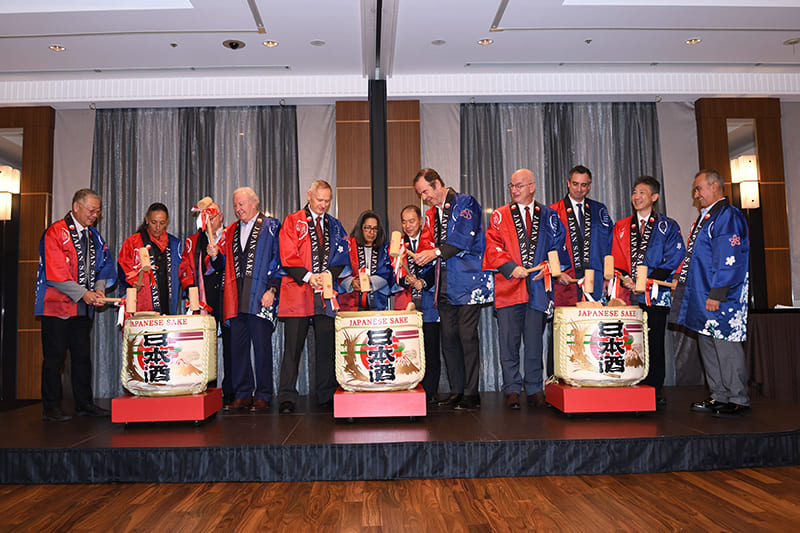
A tasting session followed Shennen’s lecture. This part of the event started with the traditional kagami biraki ceremony, in which the lid of a sake barrel is broken open with a wooden mallet. The lid is likened to a mirror (kagami), and opening it is believed to open a way to good fortune. Ambassadors from Ecuador, New Zealand, Haiti, Albania and Mexico, clad in happi festival jackets, broke the lid with the shout “One, two, three, yoisho!” to loud cheers and applause.
Then JSS Managing Director Akira Koga led a toast. “Autumn is the time when sake with an increased umami flavor is shipped, and it’s a time of year when we Japanese often say to each other, ‘it’s now the season when sake tastes great.’ Please enjoy delicious sake to your heart’s content today,” he said, raising his glass and shouting “Kanpai!”
The drink used in the toast was Masumi Sparkling Origarami. In addition, 16 other sake brands were placed on the table: three of them fruity, four light and smooth, four full-bodied, four matured and one brand of nigori sake, which retains fine particles of rice and kōji, giving it a cloudy appearance. Attendees were asked to try them with six different cheeses and vote for the combinations they liked.
The cheeses were the hard mimolette, semi-hard Gouda, washed-rind Pont-l’Eveque and bloomy-rind Camembertand, the goat cheese Sainte-Maure and the blue cheese Fourme d’Ambert.
“I usually prefer sparkling sake because it’s a bit like champagne and I think it’s easy for us to drink,” an attendee from New Zealand said. “But today, I tried nigori for the first time and realized how good it is. It has a rich flavor, and I think it goes well with goat cheese with a light taste.”
Also on the table were a variety of dishes, including curry, roast beef, roasted pork, garlic shrimp and sauteed sea bream. The organizers’ intentionally excluded Japanese food and instead offered dishes that are favored overseas so attendees could explore how well sake pairs with them, according to a JSS spokesperson.
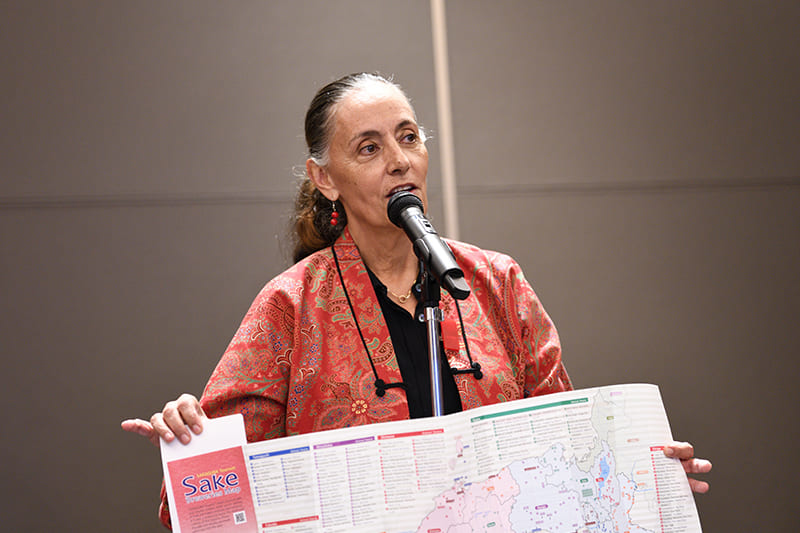
“Sake goes well with anything. It’s an all-rounder. When you drink it with food, it makes your food so good,” a participant from Panama said. “I also didn’t know there are so many kinds of sake. I now feel like trying different kinds while I am in Japan.”
According to a staffer who was pouring sake at tables, the most popular sake was Kenbishi Zuisho 5-Year Aged, a blend of sakes that have been aged for at least five years. Slightly yellow, it has a smooth mouthfeel and lingering umami, according to its maker.
The voting results revealed many attendees preferred combinations of Fourme d’Ambert cheese with light and smooth or matured sakes, while others preferred Camembert with fruity sakes.
The event, which lasted about 2½ hours, concluded with remarks by Mexican Ambassador Melba Pria. “Sake is a symbol of Japan’s traditions, and talking about sake leads to learning about Japanese history and culture. It also gives us an opportunity to think about the environment where topics like rice and water are concerned,” Pria said. “Today we learned a lot from the sake. My wish is that you will go on to play an active role as ambassadors of sake.”
The event ended on a high note amid lively conversations among attendees that felt like they could go on forever.